NH3CRAFT: what three years of research taught us about storing ammonia on ships

Updated: 6 hours ago

Ammonia contains no carbon, which makes it one of the fuels shipping is looking at for deep decarbonisation. It is also toxic, and storing large volumes of it safely on board is one of the hardest parts of using it. NH3CRAFT, a three-year Horizon Europe project coordinated by Hydrus with enisolv as a partner, set out to tackle exactly that.
The project at a glance
Full title: Safe and efficient storage of ammonia within ships
Duration: June 2022 to May 2025
Programme: Horizon Europe, with UK partners supported by UK Research and Innovation
Consortium: 12 partners from 6 countries, coordinated by Hydrus
Budget: €12.86 million, of which €8.50 million was EU funding
The partners brought together shipping, engineering, manufacturing, classification and research: Hydrus, enisolv, Columbia Shipmanagement, EKME, Connova, RINA, ABS, TWI, TU Dresden, the National Technical University of Athens, the University of Strathclyde and WEGEMT.
What the project set out to do
The goal was storage technology for large quantities of ammonia that is safe, commercially attractive and scalable. The reference case was a 31,000 DWT multipurpose vessel with modular tanks holding 1,000 m³ of ammonia at 10 bar.
Storing ammonia at around 10 bar and ambient temperature is an alternative to refrigerated storage at about −33 °C and atmospheric pressure. The aim was to show that this approach could be designed, approved and integrated on a real ship.
What was achieved
Tanks: both metallic and composite ammonia fuel tanks were designed, fabricated and tested. EKME built the steel tanks and Connova the composite ones, which passed a burst test above 61 bar against a 50-bar target. TU Dresden designed the containerised composite tanks.
Demonstrator: detailed engineering was completed for a full-scale retrofit of a 31,000 DWT general cargo vessel. Regulatory constraints reduced the planned storage capacity from 1,000 m³ to 735 m³, and the final design was approved at that size.
Validation: land-based tests using a non-toxic medium validated the bunkering and fuel transfer processes. The core technologies reached Technology Readiness Level 7, a system prototype demonstrated in an operational environment.
Desktop studies: basic designs were developed for five vessel types, from a 50,000 DWT bulk carrier and tanker to a 2,700 TEU container ship and two ferries, covering both retrofits and newbuilds.
Safety: HAZOP and FMEA workshops on the five designs identified 379 hazards and 620 risk-ranked items, and a quantitative risk assessment (QRA) was presented at IMO level. One clear finding: immediate detection and manual shutdown within 30 seconds are critical for managing an ammonia leak at sea.
Class approval: ABS issued an Approval in Principle and a new technology maturity statement, with recommendations for integrating the design into class rules.
Economics and environment: life cycle assessment (LCA) and life cycle cost analysis (LCCA) by TWI confirmed technical feasibility and economic potential. Composite tanks cost more up front but save on maintenance over their life.
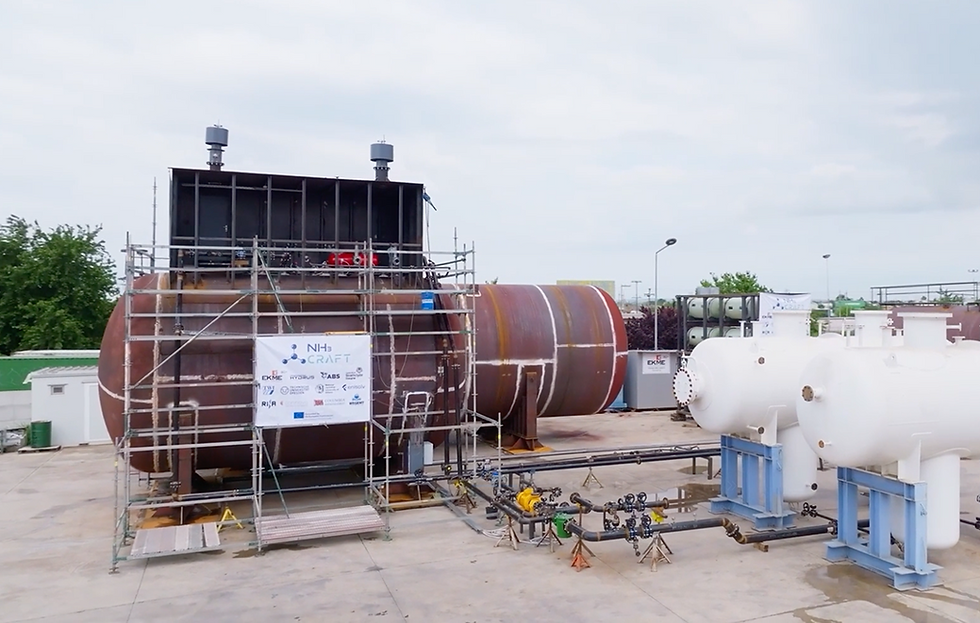
Land-based validation of bunkering and fuel transfer. Photo: NH3CRAFT project.
Our part: the digital platform
enisolv developed the project's digital tools together with TU Dresden, and delivered two platforms:
A design and retrofit platform that takes the end user's input and works out ammonia fuel requirements, tank configurations and regulatory recommendations for a given ship.
A real-time monitoring platform that tracks ammonia-specific parameters and safety indicators. It was implemented and validated during the project's final demonstration in Thessaloniki in May 2025.
Behind both sits a digital replica of the onboard ammonia system, used to simulate efficiency and safety scenarios under different operating conditions. Our naval architects made sure the software reflected real ship design constraints, and our technology team built the vessel data models and coordinated the digital deliverables across partners.
A new fuel needs reliable data from the first day it is on board.
The principle is the same one we apply to vessel reporting today. Whatever the fuel, the figures that feed safety decisions, performance analysis and regulatory reports are only as good as the data behind them.
What the project taught
Regulation shapes the design. Rules, not engineering limits, set the demonstrator's capacity: 735 m³ instead of the planned 1,000 m³.
Safety rules need harmonising. The risk assessment showed the need for consistent ammonia exposure limits across classification societies.
Dual-fuel ships come first. The project identified ammonia-ready dual-fuel vessels, particularly tankers and merchant ships with few people on board, as the most practical near-term route.
Supply matters as much as the ship. Uptake depends on ammonia production and bunkering infrastructure, and on regulatory harmonisation.
Why it matters now
From January 2026, the EU ETS for shipping will also cover nitrous oxide (N₂O), a known by-product of burning ammonia. At IMO, the Marine Environment Protection Committee approved draft regulations for a global fuel standard and greenhouse gas pricing in April 2025, with adoption planned for October 2025. Both will shape the economics of zero-carbon fuels such as ammonia.
For owners weighing their options, NH3CRAFT's results give a practical, class-reviewed view of what ammonia storage on board involves today.
Find out more
The project's final weeks brought three demonstration days at EKME's facilities in Thessaloniki on 12–14 May 2025 and a final event in Athens on 15 May 2025.
The project's deliverables and publications, including peer-reviewed papers on safety, life cycle cost, life cycle assessment and a digital twin of the ammonia fuelling system, are listed on the project website and the EU's CORDIS page.
NH3CRAFT received funding from the European Union's Horizon Europe research and innovation programme under grant agreement No 101056831. Views and opinions expressed are those of the author(s) only and do not necessarily reflect those of the European Union or CINEA. Neither the European Union nor the granting authority can be held responsible for them.

Comments